


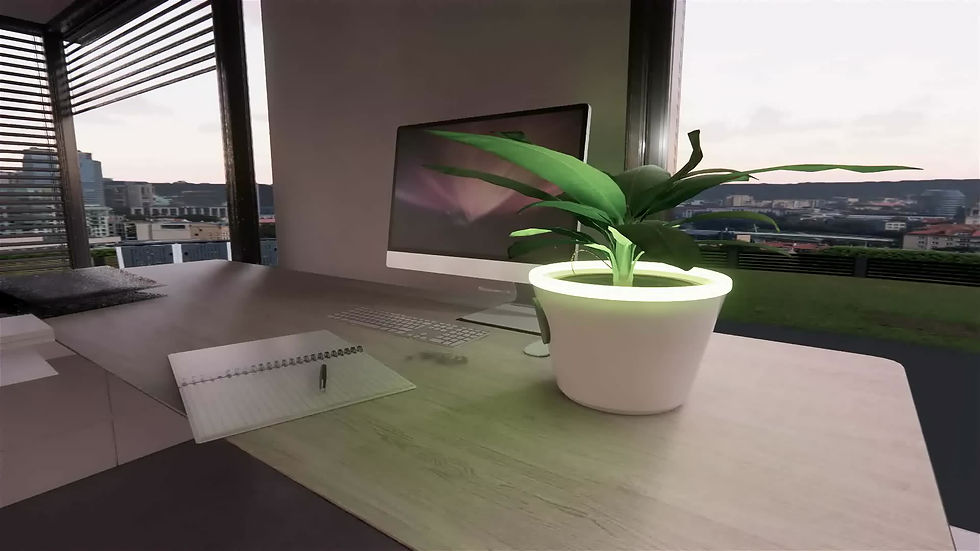
Waterly
A smart plant pot that takes care of your plant
My Role
Product design, Subject study, UX Research, Concept ideation, interaction design, Physical prototype, coding, 3D modeling,
Tools
Figma, Procreate, Arduino, Processing, Teachable Machine
Duration
04 weeks
Team
Bhumika Sharma
Yihang Ouyang
Yunong Wu
Location
Human-Computer Interaction Design,
California College of the Arts
Date
Feb 2022- March 2022
Post-humanism Design Challenge
Teams were asked to investigate ways of using technology to facilitate harmonious cohabitation between human and nonhuman agents.
We decided to explore this theme through the lens of Human-Plant Interaction, specifically, human-pet relationships, a topic that has a long history and has gained more attention in the context of a global pandemic.
The Solution
Waterly is a smart plant-pot that helps the plant owners to take care of their plants with the help of camera-based plant identification and watering reminders.
Product Highlight
1
Easy plant recognition
The pot is able to identify the kind of plants by using the camera and adjust the soil moisture required for the particular plant.
The pot is able to monitor and track the soil moisture of the plant with the help of soil moisture sensor embedded in the pot.
2
Soil moisture monitoring
3
Water plant
reminder
The pot reminds the user to water the plant by changing the color of top of the pot to red from green and also as a voice reminder.
Process
We divided our four weeks into three parts using the Three P's of Design Thinking: Immersion, Ideation and Prototyping

Formative Research Methods
Secondary Research
We started with secondary research to get familiarize with the context of human-plant relationships. We conducted a literature review of four scholarly articles with the following topics:
-
Plant owners in America
-
Plant-human relationships in the domestic sphere
User Interviews
The next stage of the process was to conduct a series of increasingly focused interviews in order to first understand our user and common problems that they experience in their life, and then gain actionable insight on a specific topic.
-
People lack knowledge about plants and how to take care of them.
-
People like having plants in their home but don’t enjoy taking care of them.
-
People lack confidence in taking care of plants.

With some plants I don’t know what I am doing wrong, and with some, I literally have to do nothing and they thrive on their own.

Survey
To gain understanding of user’s level of confidence with caring for their house plants we created a short online survey using Google Forms.
I kill every plant I bring home
I have no idea what I am doing, some plant die and some plants live
I have little bit of idea of what I am doing.
I am a total pro. My plants are thriving.

Ideation
To test the concept of Algo smart collar, we first discussed and outlined the potential use case scenarios through storyboards and sketches. I made a 3D model for our team to discuss the smart collar’s form, materiality, and possible embedded technologies.

Waterly
We prioritized this idea based on Trifecta for Innovation.
-
Desirability: It benefits both the human and the plants by communicating the plant's wellbeing information to plant owners in an understandable way.
-
Viability: A smart pot can be widely accessible to plant owners and have the least limitations such as cost and location
-
Feasibility: The current technology is able to achieve the goal of Waterly effectively.

Prototyping a solution
Sensors
The smart pot tracks the soil moisture of the plant, identifies the kind of the plant, reminders, and notifies the moisture reading. This is how it’s done using embedded technologies:
-
The web camera located on the outer surface of the pot identifies the kind of a plant with teachable machine by looking for patterns among massive data loads, and when it sees one, it adjusts the program to reflect the specific soil moisture range for that particular plant.
-
The capacitive soil moisture sensor located on the inside of the pot tracks the moisture of the soil.
-
Located on the pot is the neo pixel LEDs that is able to measure the moisture level. Depending on the specific plant's data, it will suggest the proper reading for moisture levels and reminds you when it needs to be watered.
-
Additionally, the pot has speakers for reminders to water the plant.

Coding and Machine Learning
Processing and Arduino
It was our first time to be working on processing. I ran my first code on Arduino for soil moisture sensor and then integrated it with teachable machine on processing.

Teachable Machine
Teachable machine helped us train the system to identify the type of a plant.

Other softwares that we explored
-
Wekinator
-
Tramontana
Form exploration

Next Step for Waterly
-
Keep improving our prototypes and increase the fidelity of our design. Moving forward, we want to incorporate features into the pot such as watering system by itself to further facilitate trust between caregivers, plants and Waterly.
-
Testing Waterly with plant owners and their plants. How are the stakeholders engaging with the product? How they understand the health data of their plants and their wellbeing? .How does it fit into their daily routines? To answer these questions, we need to test Waterly in real life.
-
Develop metrics to evaluate the effectiveness of Algo in facilitating trust. We need to think about how to measure trust between humans and dogs. It will help us improve the product or find better ways to facilitate trust in the relationship between pets and humans.
My Takeaways
-
Communication is everything. Everyone has their own way of understanding design and product. There is no single approach. Since it was out first time working with interactive objects and prototype, communication was extremely valuable. It helped our team to be on the same page every step in our design process and ultimately benefit the final design.
-
Sometimes less is more. The first version of Waterly did not go as we expected because we wanted it to add everything as a product, but as we refined and tested it through, we were able to eliminate few features that didn't seem feasible due to time restrictions and we were able to improve the experience of Waterly as we went through the iterations.
-
Embracing ambiguity. This is so important because it keeps us open to change, which support growth. It also reminds us to not be afraid to pivot for a better solution.